Connected Realities: Reflections on Workplace Design

Design inspiration

Key ideas, materials and shifts shaping the next phase of workplace design

Key ideas, materials and shifts shaping the next phase of workplace design

Date
April 6, 2026
Topic
Design inspiration

Oops! Something went wrong while submitting the form.

As a Technical Designer at Woodhouse Workspace, Emily Bex operates at the point where creative intent is translated into physical reality. Her role ensures that ideas are not only compelling, but deliverable, compliant and commercially viable.

This involves a strong understanding of materials, construction methods and technical detailing, alongside close collaboration with designers, suppliers and contractors to resolve challenges before they reach site.

Emily’s work is grounded in practicality without losing sight of design ambition. She considers how spaces will be built, used and maintained over time, from durability and safety through to overall performance.

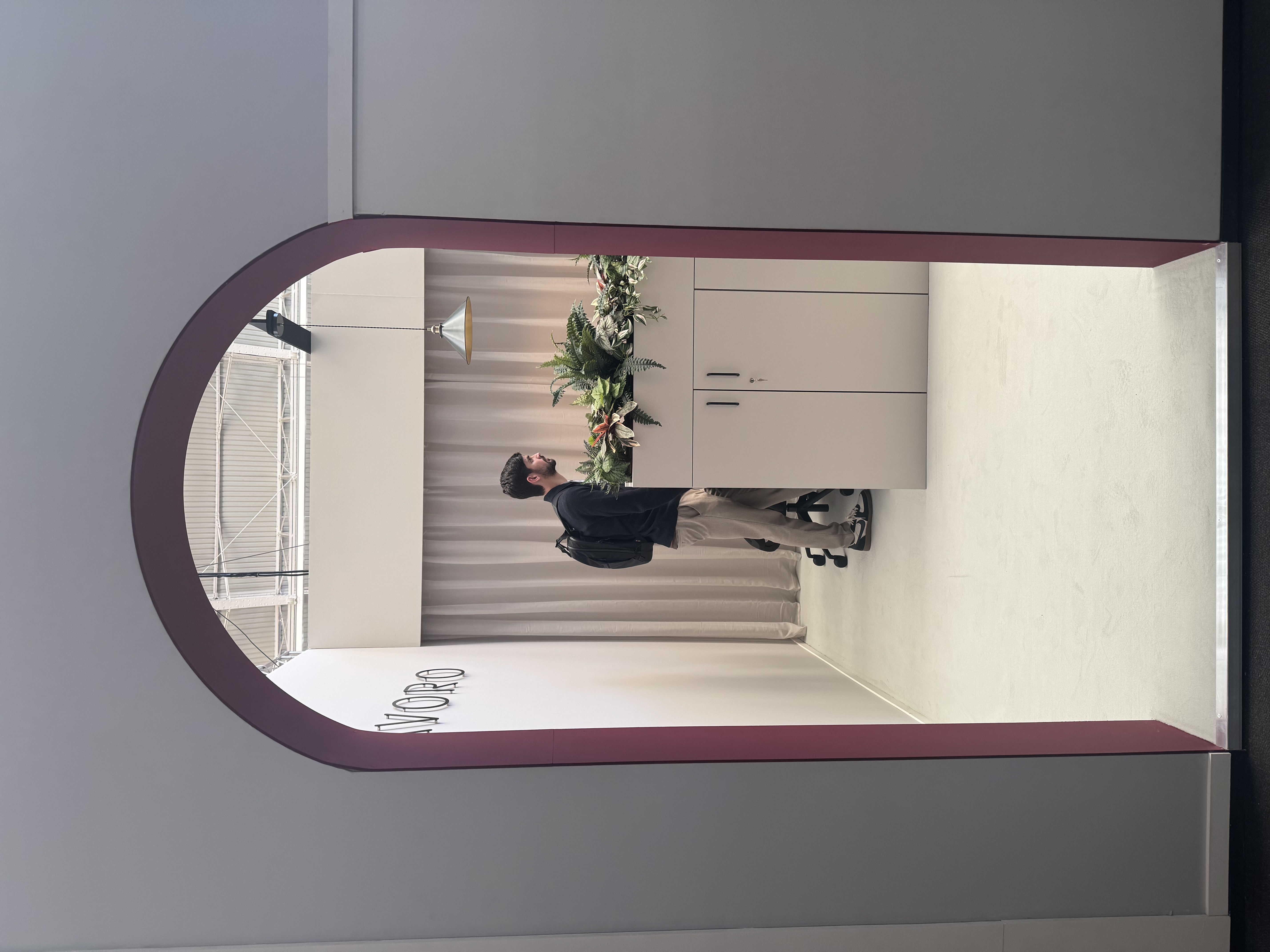
Following this year’s Workspace Design Show at the Business Design Centre in London, Emily reflects on the ideas, materials and conversations shaping how workplaces look, feel and perform in practice.

I recently visited the Workspace Design Show, and as always, it was a valuable temperature check for the industry.

I spent most of my time on the stands rather than in the talks. For me, the real insight comes from conversations with suppliers—seeing products up close, understanding how they are made, how they perform, and how they could realistically be specified within a project. It's often in these conversations that you get a clearer sense of what will actually translate into a live environment.

What stood out most? Busy. Busier than last year, in fact. And refreshingly, fewer phone booths. It felt like the industry has moved past endless variations of the same pod—less replication, more considered innovation.

The theme this year, Connected Realities, explored how physical and digital experiences are converging in the workplace. On the exhibition floor, that translated less into overt tech and more into thoughtful material innovation and smarter integration.

Sustainability: No Longer a Selling Point, Just Expected

Sustainability didn’t feel like a headline this year—it felt embedded.

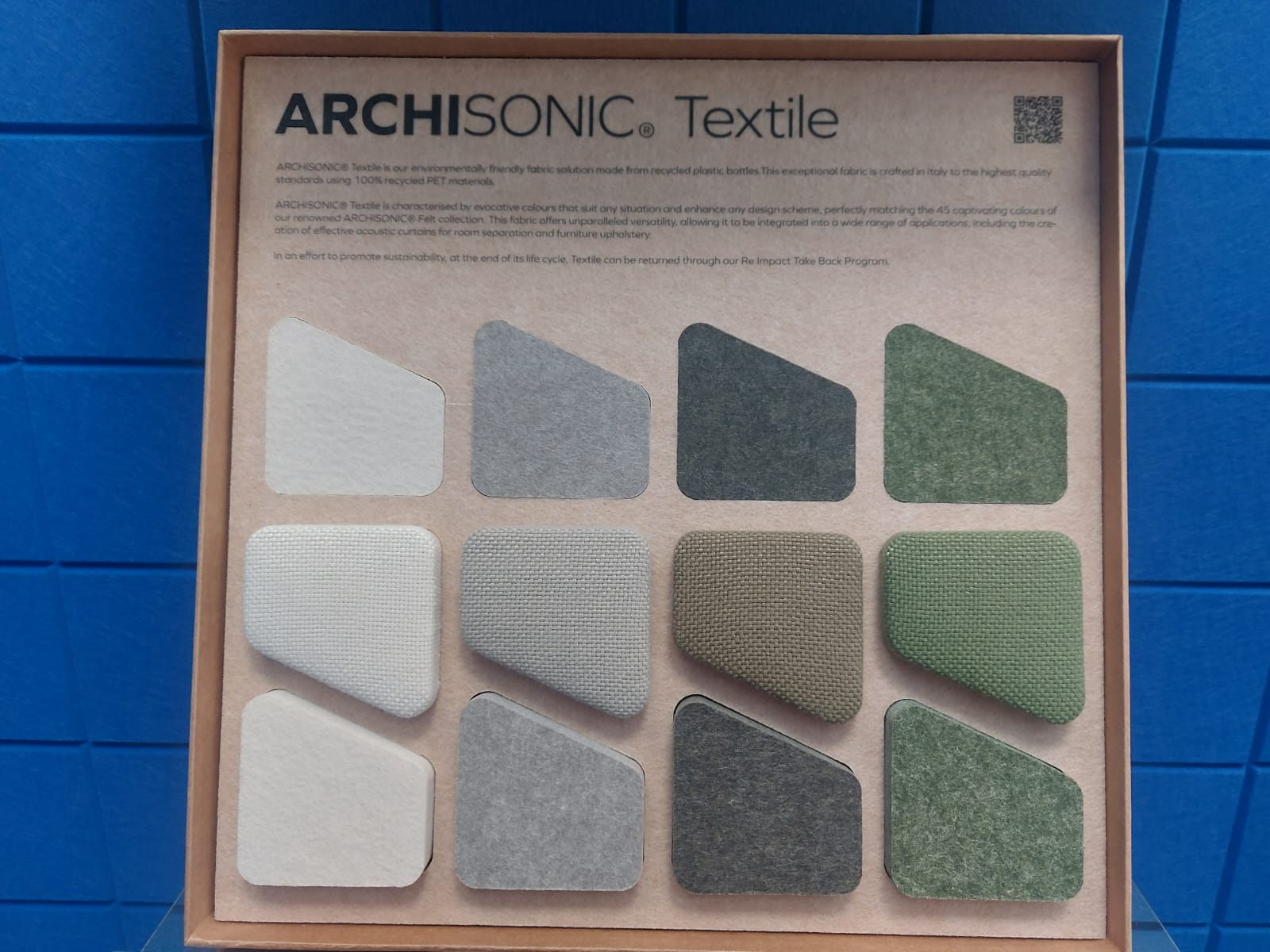
One of the most interesting stands for me was Impact Acoustic. Rather than simply displaying products, they created a lab-style setup that took visitors behind the scenes of how their acoustic solutions are tested and developed.

What really caught my attention was their ARCHISONIC® Cotton material. Made from cotton cellulose—a by-product of the cotton industry—combined with other natural raw materials, it is fully recyclable and compostable, designed for a closed-loop lifecycle. It represents a clear move away from synthetic binders towards healthier, circular alternatives.

It’s encouraging to see innovation that balances performance, particularly acoustic absorption, with environmental responsibility. This is increasingly what we expect to specify, as sustainable materials become the baseline rather than the exception.

Another standout was Mogu, whose acoustic panels are grown from mycelium using upcycled textile residues. The panels form directly in moulds, creating organic textures that feel inherently different to anything manufactured.

There’s something powerful about materials that are grown rather than made. It connects to biophilic design in a more authentic way—not just introducing greenery, but embedding nature into the fabric of the space itself.

Designing for Feeling, Not Just Function

The show’s overarching message was about environments we engage with and belong to. Across the exhibition floor, that emotional layer felt front and centre.

Colour played a big role. While soft neutrals are still present, there is a clear move towards bolder, deeper tones. Rich colours that add personality and confidence, stepping away from the safer palettes of recent years.

Products themselves are doing more of the emotional work. Texture, tactility and material authenticity all influence how a space feels, and in turn, how people feel within it.

As I often say, we do not just design a space. We design how it is experienced — and this shift towards more sensory, human-centred environments is something we are increasingly seeing reflected in project briefs.

The Details That Elevate a Space

One stand that really resonated was Daisalux. Emergency lighting is not typically the star of a design show, which is exactly why it stood out.

Too often, thoughtfully designed spaces are compromised at the final hurdle with generic exit signage. Daisalux showcased emergency luminaires that integrate seamlessly into architectural schemes. Discreet, considered and design-led.

It is a reminder that the smallest details can either undermine or elevate a project — and that good technical design ensures compliance does not come at the expense of concept.

Community and Productivity

There is often a debate around whether workplaces should prioritise community or productivity, but in reality, the most effective environments need to achieve both.

Spaces still need to perform. They must support focused work, collaboration and meetings, reflected in the subtle return of more defined meeting rooms alongside open-plan areas. At the same time, workplaces need to attract people back in, offering comfort, personality and a sense of belonging that competes with home.

This balance is being achieved through more considered design. Softer materials, warmer palettes and residential influences help humanise spaces, while careful planning ensures they remain practical and efficient.

Ultimately, successful workplaces align experience with performance, delivering environments that feel good to be in and work effectively within real-world constraints such as budget and delivery.
Thank you for requesting a copy of our latest download, Woodhouse Workspace - Achieving a shared management vision for people, place and pulse - Whitepaper.
Oops! Something went wrong while submitting the form.

Like to know more about how we design workplaces?

Connected Realities: Reflections on Workplace Design

Design inspiration

Key ideas, materials and shifts shaping the next phase of workplace design

Key ideas, materials and shifts shaping the next phase of workplace design

Date
April 6, 2026
Topic
Design inspiration

Oops! Something went wrong while submitting the form.

As a Technical Designer at Woodhouse Workspace, Emily Bex operates at the point where creative intent is translated into physical reality. Her role ensures that ideas are not only compelling, but deliverable, compliant and commercially viable.

This involves a strong understanding of materials, construction methods and technical detailing, alongside close collaboration with designers, suppliers and contractors to resolve challenges before they reach site.

Emily’s work is grounded in practicality without losing sight of design ambition. She considers how spaces will be built, used and maintained over time, from durability and safety through to overall performance.

Following this year’s Workspace Design Show at the Business Design Centre in London, Emily reflects on the ideas, materials and conversations shaping how workplaces look, feel and perform in practice.

I recently visited the Workspace Design Show, and as always, it was a valuable temperature check for the industry.

I spent most of my time on the stands rather than in the talks. For me, the real insight comes from conversations with suppliers—seeing products up close, understanding how they are made, how they perform, and how they could realistically be specified within a project. It's often in these conversations that you get a clearer sense of what will actually translate into a live environment.

What stood out most? Busy. Busier than last year, in fact. And refreshingly, fewer phone booths. It felt like the industry has moved past endless variations of the same pod—less replication, more considered innovation.

The theme this year, Connected Realities, explored how physical and digital experiences are converging in the workplace. On the exhibition floor, that translated less into overt tech and more into thoughtful material innovation and smarter integration.

Sustainability: No Longer a Selling Point, Just Expected

Sustainability didn’t feel like a headline this year—it felt embedded.

One of the most interesting stands for me was Impact Acoustic. Rather than simply displaying products, they created a lab-style setup that took visitors behind the scenes of how their acoustic solutions are tested and developed.

What really caught my attention was their ARCHISONIC® Cotton material. Made from cotton cellulose—a by-product of the cotton industry—combined with other natural raw materials, it is fully recyclable and compostable, designed for a closed-loop lifecycle. It represents a clear move away from synthetic binders towards healthier, circular alternatives.

It’s encouraging to see innovation that balances performance, particularly acoustic absorption, with environmental responsibility. This is increasingly what we expect to specify, as sustainable materials become the baseline rather than the exception.

Another standout was Mogu, whose acoustic panels are grown from mycelium using upcycled textile residues. The panels form directly in moulds, creating organic textures that feel inherently different to anything manufactured.

There’s something powerful about materials that are grown rather than made. It connects to biophilic design in a more authentic way—not just introducing greenery, but embedding nature into the fabric of the space itself.

Designing for Feeling, Not Just Function

The show’s overarching message was about environments we engage with and belong to. Across the exhibition floor, that emotional layer felt front and centre.

Colour played a big role. While soft neutrals are still present, there is a clear move towards bolder, deeper tones. Rich colours that add personality and confidence, stepping away from the safer palettes of recent years.

Products themselves are doing more of the emotional work. Texture, tactility and material authenticity all influence how a space feels, and in turn, how people feel within it.

As I often say, we do not just design a space. We design how it is experienced — and this shift towards more sensory, human-centred environments is something we are increasingly seeing reflected in project briefs.

The Details That Elevate a Space

One stand that really resonated was Daisalux. Emergency lighting is not typically the star of a design show, which is exactly why it stood out.

Too often, thoughtfully designed spaces are compromised at the final hurdle with generic exit signage. Daisalux showcased emergency luminaires that integrate seamlessly into architectural schemes. Discreet, considered and design-led.

It is a reminder that the smallest details can either undermine or elevate a project — and that good technical design ensures compliance does not come at the expense of concept.

Community and Productivity

There is often a debate around whether workplaces should prioritise community or productivity, but in reality, the most effective environments need to achieve both.

Spaces still need to perform. They must support focused work, collaboration and meetings, reflected in the subtle return of more defined meeting rooms alongside open-plan areas. At the same time, workplaces need to attract people back in, offering comfort, personality and a sense of belonging that competes with home.

This balance is being achieved through more considered design. Softer materials, warmer palettes and residential influences help humanise spaces, while careful planning ensures they remain practical and efficient.

Ultimately, successful workplaces align experience with performance, delivering environments that feel good to be in and work effectively within real-world constraints such as budget and delivery.

Thank you for requesting a copy of our latest download, Woodhouse Workspace - Achieving a shared management vision for people, place and pulse - Whitepaper.
Oops! Something went wrong while submitting the form.

Like to know more about how we design workplaces?

Cookie Consent

By clicking “Accept”, you agree to the storing of cookies on your device to enhance site navigation, analyze site usage, and assist in our marketing efforts. View our Privacy Policy for more information.

Cookie